

Last night we arrived at Stanford University in Palo Alto.
I can’t disclose much about what we are doing here. So I’ll share what else caught my attention.
Before dinner, I went for a run. It’s one of my strategies for beating jet lag after the flight from the UK: get outside, move, stay awake until evening, earn a good night’s sleep.
The run took me through Silicon Valley’s origin story.
I’ve always loved founder stories. They give me perspective. When you build something from scratch, as we are with Paddle Games, it is easy to look at established organisations and see only what they are today. You see the finished product. You don’t see the uncertainty, mistakes, improvisation and persistence that came before it.
Few places remind you of that better than Silicon Valley.
I passed the Apple Store on University Avenue. It opened in 2001 and was Apple’s first ever street-level store, part of Steve Jobs’ vision to rethink not only the products Apple made, but how people experienced them.
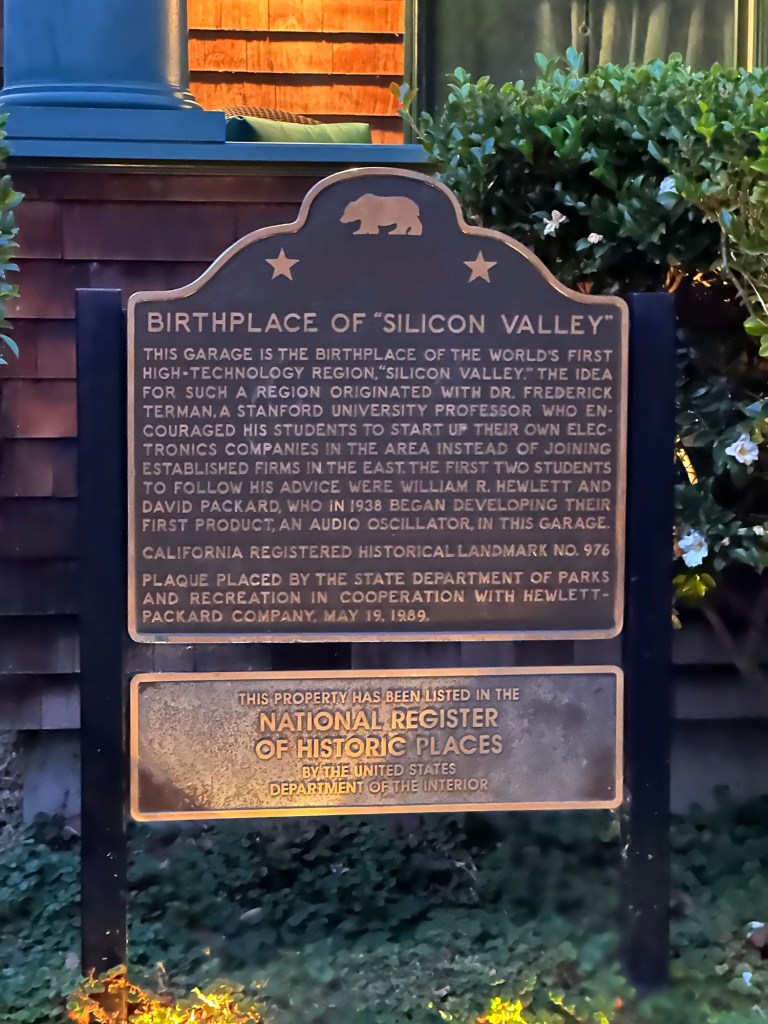
From there, I reached 367 Addison Avenue and the HP Garage, often called the birthplace of Silicon Valley. Hewlett-Packard started there in 1939.
Decades later, two young men from the area, Steve Jobs and Steve Wozniak, grew up immersed in the electronics culture that HP, Stanford and the wider valley had helped create.
That friendship became Apple.
And this is the part of founder stories I find most interesting.
We know what happened next. They didn’t.
We tend to tell these stories backwards. Once something becomes successful, the early decisions suddenly look like part of a masterplan. The garage becomes legendary. The first product becomes historic. The founders become visionaries.
But at the time, they were simply trying to make the next thing work.
Wozniak built the computer that became the Apple I because he loved building things. He showed it to fellow enthusiasts at the Homebrew Computer Club, which met nearby. Jobs saw the possibility of turning it into something more.
One of their first big breaks came when Paul Terrell, owner of the Byte Shop in nearby Mountain View, ordered 50 assembled Apple I computers.
Today, that sounds like the beginning of Apple.
At the time, it was just an order they had to figure out how to fulfil.
I love that.
Because it gives me perspective on Paddle Games.
We started with an idea: bring canoeing closer to people, make racing simple and exciting, make athletes the heroes, and present our sport differently.
We didn’t have everything figured out.
We still don’t.
We’ve had small budgets, ideas that worked and others that need improving, people who believed in us early, athletes willing to try something different, partners prepared to take a chance, and a lot of learning along the way.
Three years later, Paddle Games is still small. But it exists. It is growing. This year we went from one event to two, Copenhagen and Palma.
And who knows where it will go from here?
Being in Silicon Valley is a good reminder not to become impatient with where something is today.
Big things nearly always look small at the beginning.
There is one final connection I particularly like.
In 2005, Steve Jobs stood here at Stanford and delivered his famous commencement speech. He talked about connecting the dots and how you can only connect them looking backwards.
Perhaps that’s one of the hardest things about building something new.
You don’t know which conversation, decision, mistake, relationship or opportunity will eventually become an important dot in the story.
You just have to keep creating the dots.
And enjoy the rocky path while you do it.


Leave a Reply